Market structure is a fundamental term in the ICT SMC strategy.
It helps traders systematically analyze charts that may initially seem chaotic, especially for beginners. Defining a trend simply by higher highs and higher lows is an oversimplification that ignores the hidden mechanisms operating “behind the candles.” Yet, these mechanisms are key to understanding why, where, and how the price moves.
Read more:
Disclaimer. ATAS is not affiliated with Michael Huddleston (Inner Circle Trader, ICT) and does not endorse or promote his trading strategies. This article is for informational purposes only, providing an overview of key market structure concepts and shifts. The goal is to demonstrate how ATAS volume analysis tools can enhance the application of the Smart Money Concept in trading.
What Is Market Structure in ICT?
While the creator of the Smart Money Concept (SMC) defines market structure differently from traditional interpretations, they share a common foundation—analyzing the sequence of swing highs (local highs) and swing lows (local lows).
Based on the positioning of these extremes, market structure is classified into three types:
- Uptrend (Higher Highs and Higher Lows, HH and HL) – each new high and low is higher than the previous one
- Downtrend (Lower Highs and Lower Lows, LH and LL) –each new high and low is lower than the previous one.
- Consolidation (Range/Flat Market) – no clear trend, with price moving within a horizontal range.
A key feature of market structure in the Smart Money Concept is its approach to interpreting price movements, where liquidity plays a central role.
Simply put, in SMC, market structure is a story of how price moves between liquidity zones.
Indicators for Identifying Market Structure
For beginner traders, the following tools can help make market structure analysis clearer and more structured:
➤ ZigZag and Fractals indicators
➤ Line chart
We covered these tools in more detail in one of our YouTube videos on the SMC cycle.
In this article, we will also use the line chart (to switch from a candlestick chart to a line chart in ATAS, press Shift + L) and the ATAS ZigZag Pro indicator.
Example of Market Structure Analysis
Below is a chart of the ES futures contract for January 2025 (using the Reversal chart type, which provides a clearer view of price swings and adapts more effectively to this instrument’s uneven intraday volatility):
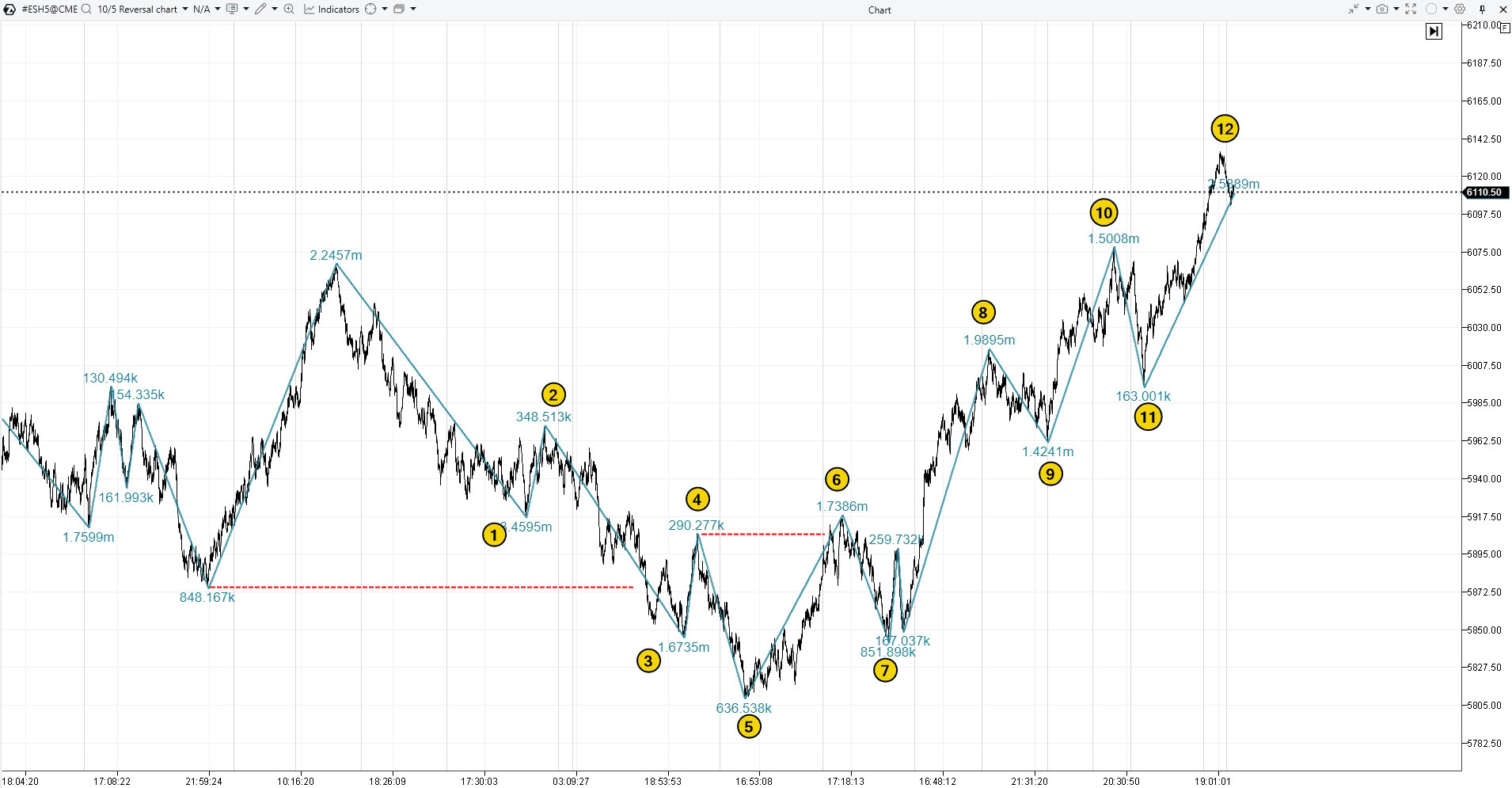
A bearish market structure is observed as the price declines from the peak on the left side of the chart, forming a sequence of LH and LL (1-2-3-4-5).
The peak at (6) is higher than the peak at (4)—this could indicate a shift in market sentiment. In the Smart Money strategy, this pattern is known as a Change of Character.
The price dropped into a liquidity zone below the 5872.50 level, triggering:
- The activation of buyers’ stop-loss orders (sell stops).
- The opening of new short positions as the previous swing low was broken.
- An increase in selling order flow driven by traders reacting to the news backdrop (typically, news tends to be more negative when the price reaches multi-week or multi-month lows).
After Smart Money absorbed the liquidity from those sellers, the price momentum shifted. A bullish structure began to form, with a sequence of HH and HL (6-7-8-9-10-11-…).
Tip. Watch the volume on each price impulse (shown as blue-green numbers). As long as volume is higher on down moves than up moves, the trend remains bearish. When the pattern reverses—meaning volume increases on up moves—the trend turns bullish. This principle is covered in detail in the article “Weis Waves.”
How to Use a Market Structure Shift in Trading
In the Smart Money Concept strategy, a Market Structure Shift (MSS) occurs when a key swing high or swing low is broken in the opposite direction of the current trend.
In the chart above, a bullish Market Structure Shift happened with the formation of the 7→8 impulse. Notice how quickly the price surged, breaking through highs 4 and 6. It almost feels intentional— as if buyers were being kept out of new long positions while sellers were left at a loss… Who knows.
An example of a bearish Market Structure Shift is shown in the screenshot below. This is a chart of Gold futures (GC) from November to December 2024.
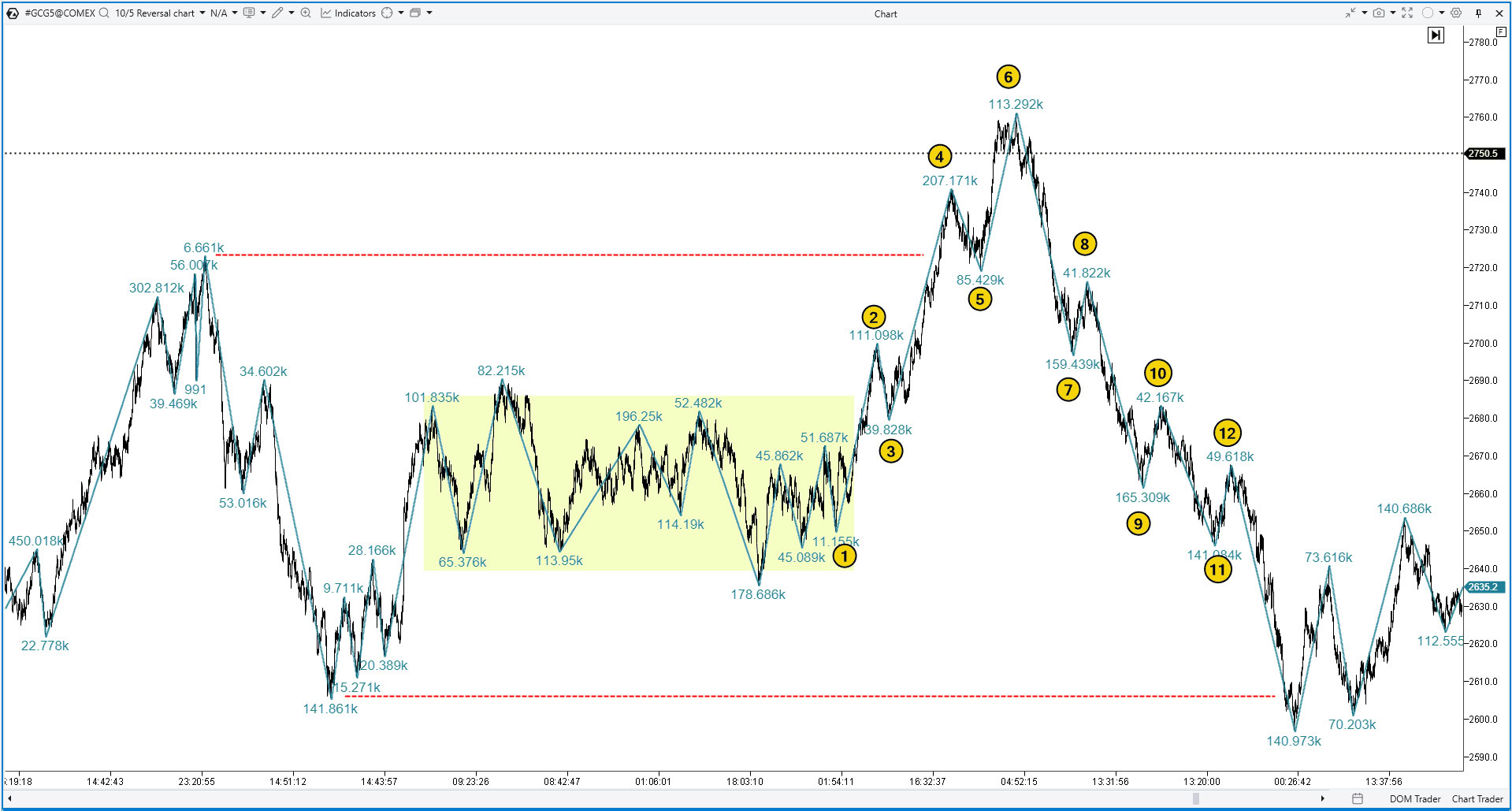
The highlighted area in the center of the chart represents a consolidation zone (flat market), which is one of the forms of market structure. The minor price fluctuations may have indicated that buyers and sellers were equally satisfied with the price level, meaning it was within its fair value range.
Then, likely influenced by news events, a bullish structure formed with a sequence of HL and HH (1, 2, 3, 4, 5, 6). As the price broke above the previous high, it entered a liquidity zone:
- Sellers were forced to close their short positions via stop-losses, triggering buy orders.
- New buyers opened long positions, possibly driven by positive news.
However, once Smart Money had fully utilized this influx of buy orders to establish their short positions, the price was ready to move downward. The 6 → 7 impulse marked a bearish MSS, signaling a trend reversal. After that, a sequence of LL and LH (7, 8, 9, 10, 11, 12, …) began forming, pushing the price into a new liquidity zone below a key previous low.
Notice that once again, the MSS shift happened during a sharp, rapid impulse, followed by only a slight corrective rebound (7→8). Making the right decision (closing a long position in time and opening a short one) was extremely challenging, and fixing a mistake came at a high cost.
Warning. The MSS pattern is simply a signal that traders should be prepared for a potential trend reversal. However, it does not guarantee that a reversal will occur. Future price movements remain unpredictable.
Integrating MSS with ICT Market Structure
Let’s take a look at another Litecoin futures chart (data from January 2025, Binance) to see how bullish and bearish market structures interact, along with the Market Structure Shift (MSS) pattern. To provide more insight, we have added the cumulative Delta indicator to help better understand the underlying processes.
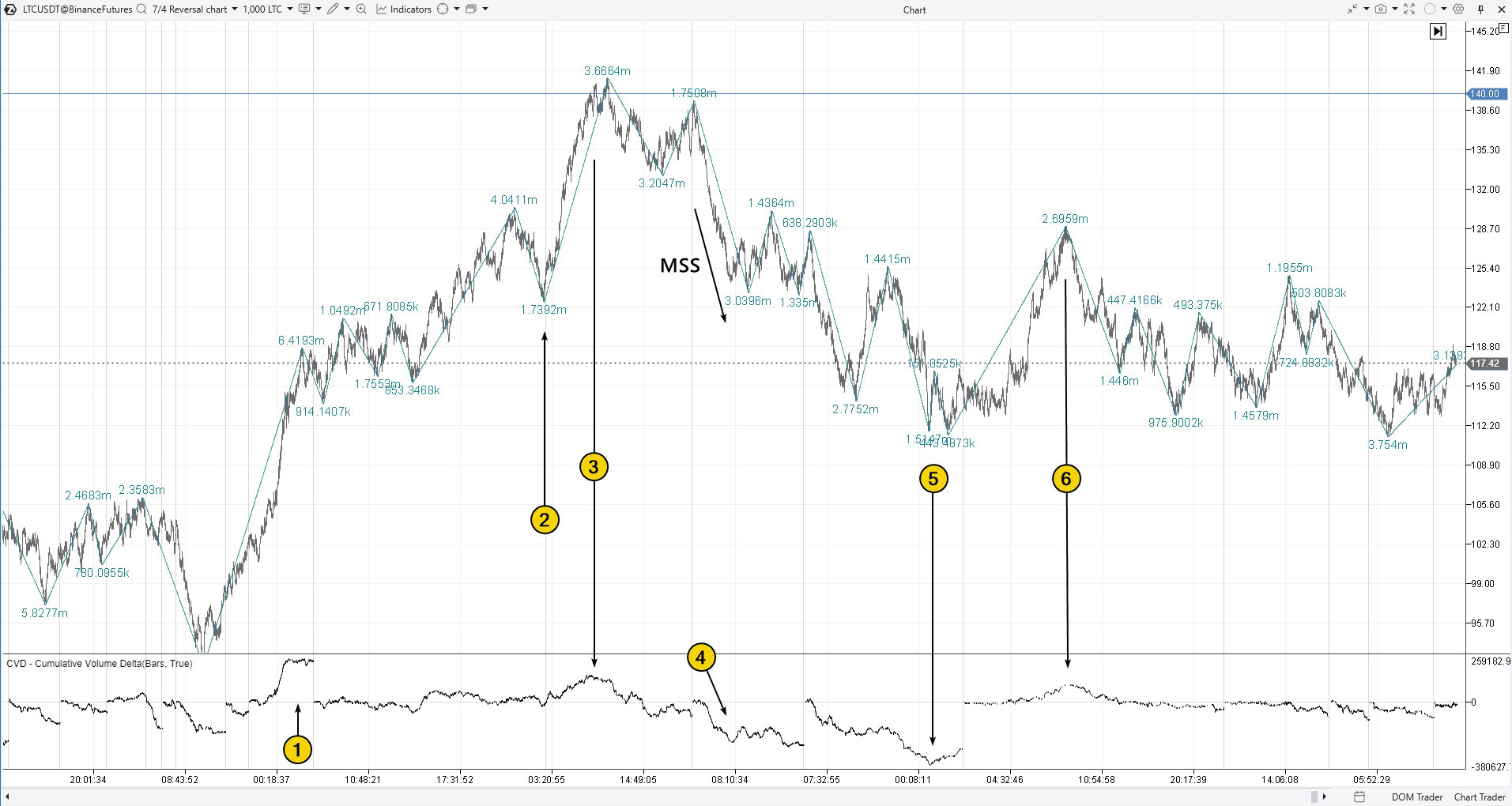
This is a story of how, in January 2025, news broke that a major financial institution had filed for an ETF registration for Litecoin. As you may know, the launch of several Bitcoin ETFs in January 2024 served as a strong bullish catalyst for BTC. Therefore, upon hearing the news about Litecoin, the market immediately responded with optimism.
This is reflected in a surge in buying activity on the cumulative Delta indicator (1), which triggered a sharp price rally. After that, a bullish structure began to form, creating a sequence of higher highs (HH) and higher lows (HL).
(2) On a smaller time frame, this decline might look like a Market Structure Shift (MSS). However, the cumulative Delta does not show significant fluctuations. This is an important signal—the structure break is not genuine. Compare this to what happened later.
(3) When the price reached the psychological level of $40 per LTC, the cumulative Delta indicator showed a surge in buying activity. This can be interpreted as a FOMO effect. In the context of the Smart Money Concept, this suggests that the price entered a liquidity zone where Smart Money could take advantage of retail buyers’ activity to:
- Close long positions and lock in profits
- Open short positions
Based on this logic, there is reason to believe that the next Market Structure Shift (MSS) will be genuine, sending the price lower in search of liquidity.
MSS is a Market Structure Shift confirmed by a surge in market sells (4) and a sharp decline with no short-term recoveries. In the Smart Money Concept (SMC) strategy, such abrupt, impulsive price movements are referred to as Displacement.
(5) The price reaches a liquidity zone, as shown by the Delta indicator dropping to an extremely low level. This signals a selling climax—retail traders panic-sell their Litecoins, providing Smart Money with ample liquidity to secure profits from their short positions.
The subsequent rise to the peak (6) could be interpreted as a structure shift. However, in this case, the market did not transition into an uptrend but instead entered a consolidation phase. It appears that Smart Money concluded their campaign here, profiting from both the rise and fall of LTC/USD, and then shifted their focus to opportunities in other assets.
Using Market Structure Shifts With Other ICT Components
Continuing our analysis of LTC/USD, let’s take a look at the peak around $40 per coin. This will help illustrate how other Smart Money Concept elements—such as the Order Block and Fair Value Gap—interact with the MSS pattern.
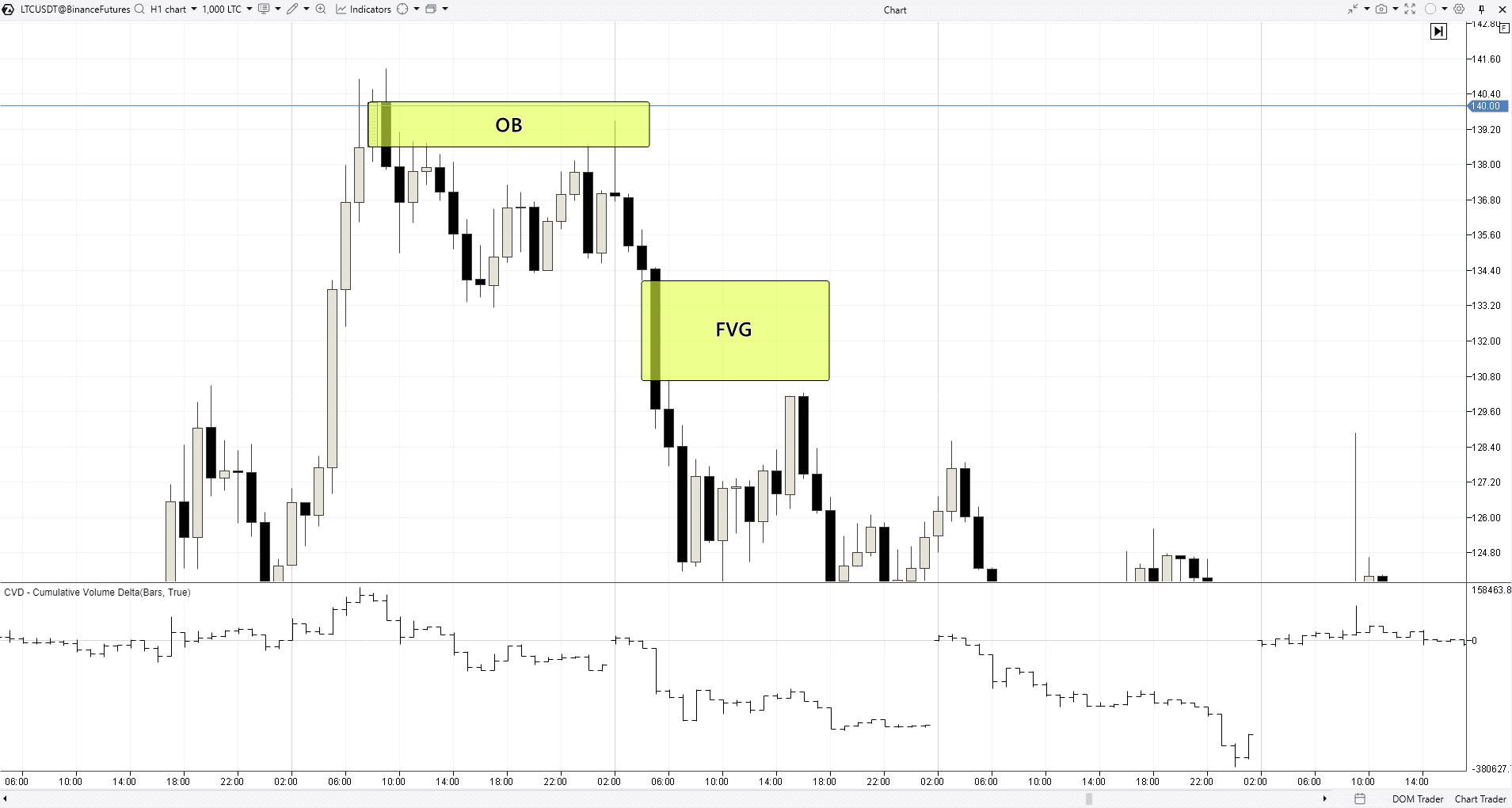
➤ OB is an Order Block zone that acted as resistance and could have been used to open short positions.
➤ FVG (Fair Value Gap) could have also been a short entry point, although, unlike OB, the price did not give a clear retest of this zone.
For more details on key Smart Money Concept patterns, check out our articles:
What is an Order Block? How to identify and use zones where Smart Money operates.
What is a Fair Value Gap? Its role in liquidity analysis.
How to Trade MSS, Order Blocks, and FVG
The approach to trading Market Structure Shifts follows a clear sequence of steps:
1️⃣ Identify the current trend
2️⃣ Find liquidity zones – key levels where a trend reversal might happen.
3️⃣ Confirm the structure shift (MSS) after the price reaches the liquidity zone.
4️⃣ Use OB and/or FVG patterns to identify the best entry for a trade.
In market structure analysis, it is important not just to spot patterns but also to confirm their reliability to avoid false signals. Advanced tools on the ATAS platform can help with this.
Example on the Chart
Let’s take a look at a bullish Market Structure Shift (MSS) on the British pound futures chart (January 2025 data from the CME exchange).
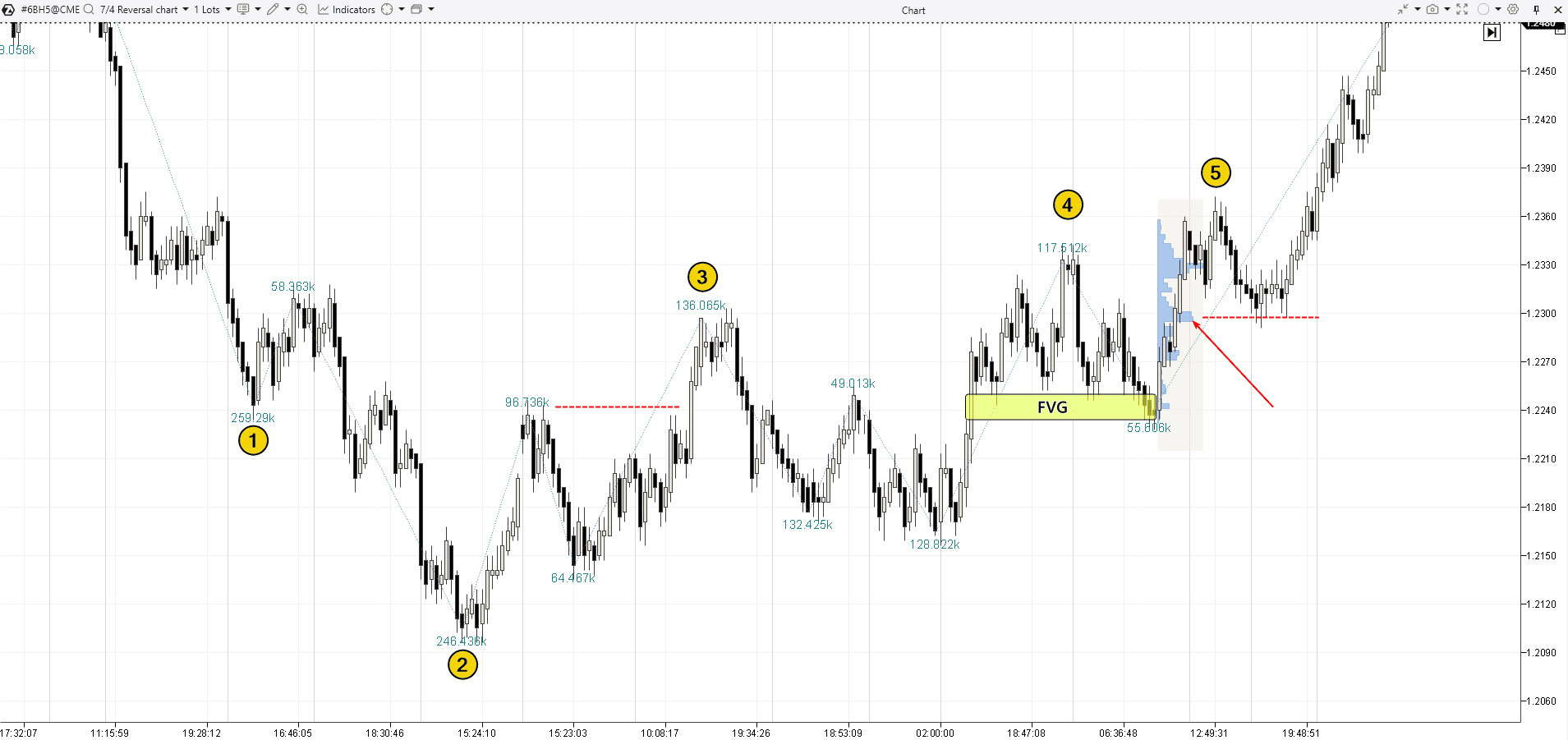
On the left side of the chart, we see a bearish market structure with LH and LL. Trading volumes are high during price declines to the lows (1) and (2), exceeding 200,000 contracts.
However, when the price rises to the peak (3), an HH forms along with the ChoCh pattern. Notice how the volume dynamics shift—volumes increase during upward movements and weaken during pullbacks. This indicates weakening selling pressure, further supporting the idea that the market structure is changing.
As the price moves above peak 3 and continues toward peak 4, there is a case for a bullish structure shift. If the trend is turning upward, traders look for an entry point into a long position. To do so, they identify an FVG area, which in this case acted as a strong support zone and could have served as an entry point for a long trade.
Notice that identifying the FVG during the rise to the peak (5) can be challenging. In this case, using a market profile built for the impulsive price increase can help identify an entry point. The bulge on this profile (indicated by the red arrow) provided a clear level for entering a long position, anticipating that the trend following the bullish Market Structure Shift would continue.
Risks of Market Structure Trading
Trading based on market structure comes with certain risks, many of which stem from the subjective interpretation of price movements:
Common mistakes in identifying market structure. False breakouts of swing highs and lows are often mistaken for a Market Structure Shift (MSS), when in reality, they may be trader traps. To avoid falling for them, it is crucial to analyze the market context and look for confirmations.
This is where ATAS, a leading platform for volume analysis, becomes a valuable tool. By analyzing horizontal and vertical volumes, Delta spikes, and footprint patterns, traders can gather solid confirmations to determine whether a Market Structure Shift is genuine or just a trap.
Explore key aspects of market analysis:
What Is a Bull Trap in Trading? – how to avoid false buy signals.
What Is a Bear Trap in Trading? – identifying traps for sellers.
Footprint Patterns – understanding market participants’ actions.
Vertical and Horizontal Volume Analysis – identifying real market interest.
Psychological pressure. Waiting for structure confirmation or a retest can create emotional stress, often leading to premature entries and impulsive decisions. To avoid these mistakes, it is essential to have a clear trading plan and stick to predefined entry and exit rules.
How Beginners Can Learn to Trade Using Market Structure
Trading is a business that requires strategic thinking, careful planning, and continuous skill improvement. Before risking real capital, it is important to master market analysis and learn to make well-informed decisions.
The ATAS platform can be an invaluable tool on this journey, offering:
- Access to detailed tick history – load and analyze historical data to improve your ability to identify market structure.
- A wide range of indicators – use professional tools and educational resources to accurately confirm Market Structure Shifts (MSS).
- Market Replay functionality – test strategies on historical market data and practice in conditions as close to real trading as possible, without risking capital.
With ATAS, traders gain market transparency, confidence in their analysis, and the ability to develop a professional-level trading system.
To start practicing, download the ATAS platform for free, install, and launch it, and then:
- Open a chart of a financial instrument.
- Click on the Market Replay button in the main ATAS menu.
- Activate the Replay mode (the icon should turn green).
- Adjust settings (date and data type).
- Start the playback and practice analyzing market structure.
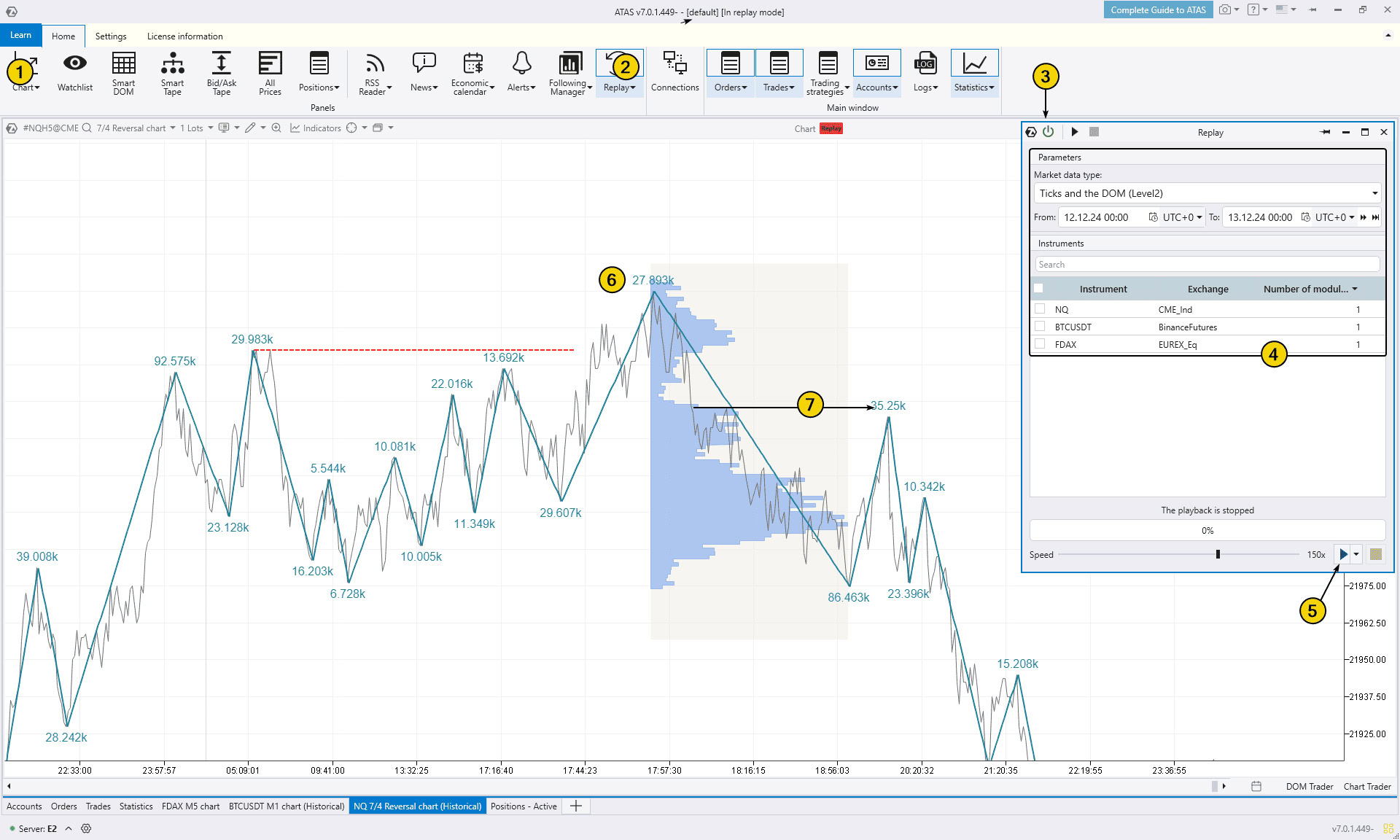
Example. The chart above shows a scenario where the price moved above previous highs into a liquidity zone, forming a peak (6). This was followed by a bearish MSS (notice the increase in volume during the downward move). A short position could have been opened (7) during the FVG test, which in this case was identified not by the classic Smart Money Concept rules but using the market profile—a narrow profile often coincides with fair value gaps.
FAQs on Market Structure
What is a Market Structure Shift?
MSS refers to a change in market structure, indicating a trend reversal.
➤ Bullish Market Structure Shift:
- The price breaks below previous lows, collecting liquidity (sell stops).
- A strong upward move follows, breaking short-term highs.
- After that, the trader looks for an FVG as an entry point for long positions.
➤ Bearish Market Structure Shift:
- The price breaks below previous highs, collecting liquidity (buy stops).
- A sharp decline follows, breaking short-term lows.
- Traders then look for an FVG as an entry point for short positions.
How to identify Market Structure Shift?
Simply put, the process involves two steps:
- Identify key swing highs and swing lows.
- Wait for a breakout of these levels in the opposite direction of the current trend.
In reality, price movements are more complex than a simple zigzag pattern. That is why traders should carefully analyze the market context and use volume analysis tools to confirm that the observed MSS is legitimate.
What is the ICT method of trading?
ICT (Inner Circle Trader) is Michael Huddleston, an American trader and creator of a popular YouTube channel where he teaches his Smart Money Concept (SMC) strategy. His approach is based on analyzing the actions of major market players and includes the analysis of liquidity zones, market structure, FVG, Order Blocks, and the idea that market behavior follows algorithmic patterns.
Learn more about ICT and the SMC concept in the article: What Is Smart Money Concept and How Does the ICT Trading Strategy Work?
What is the difference between MSS and BOS in ICT?
The difference between MSS and BOS is as follows:
- MSS is a reversal pattern. It signals a trend change when the price breaks a key swing high or low.
- BOS is a trend continuation pattern. It confirms the ongoing trend when the price breaks a level in its direction.
Conclusion
Trading with Market Structure Shift (MSS) is a core approach within the Smart Money Concept strategy, providing traders with a structured way to analyze price movements. Understanding key elements like liquidity zones, Order Blocks, and FVG helps traders develop effective trading strategies.
Advantages:
✔ Well-founded entry signals – traders align their positions with major market participants.
✔ More predictable price movements – traders learn to identify liquidity zones, which serve as key “departure and destination points” for market trends.
Disadvantages:
✘ Requires time and practice – without proper preparation, traders may struggle to accurately identify market structure and its shifts.
✘ False breakouts can be misleading – effective use of market structure concepts requires considering the market context and paying close attention to volume.
The BOS and MSS patterns described in this article provide a solid foundation for beginner traders looking to understand market movements. The ATAS platform, with its advanced tools—such as Market Replay and volume analysis indicators—makes it easier to study market structure and improves the learning process without risking capital. With ATAS, traders gain market transparency, confidence in their analysis, and the ability to develop their trading system at a professional level!
Download ATAS. Once you install the platform, you will automatically get the free START plan, which includes cryptocurrency trading and basic features. You can use this plan for as long as you like before deciding to upgrade to a more advanced plan for additional ATAS tools. You can also activate the Free Trial at any time, giving you 14 days of full access to all the platform’s features. This trial allows you to explore the benefits of higher-tier plans and make a well-informed purchasing decision.
Do not miss the next article on our blog. Subscribe to our YouTube channel, follow us on Facebook, Instagram, Telegram or X, where we publish the latest ATAS news. Share life hacks and seek advice from other traders in the Telegram group @ATAS_Discussions or on Discord.
Information in this article cannot be perceived as a call for investing or buying/selling of any asset on the exchange. All situations, discussed in the article, are provided with the purpose of getting acquainted with the functionality and advantages of the ATAS platform.